parody (III): The proceedings 
We come now to the analysis of those specific procedures that enable the transformation of text into a hypertext, and can make any relationship between parody and original texts, thus amplifying the comic element. Building on the analysis Harries, I was able to highlight five main processes: the repetition, deconstruction-inversion, the literalization, the inclusion of a foreign element exaggeration.
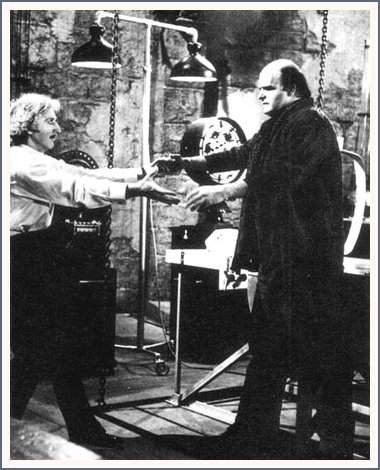
The repetition of easily recognizable elements serves to highlight and strengthen the similarities of parody with the reference text. We have already said that within a text, we have the presence of parodic elements of similarity and inconsistency, and that both are essential to create a fun conflict. The iconography of a genre film is an often subject to repetition: the Frankenstein junior careful philological recreation of the setting, music, photography and black and white horror film style of the '30s created a striking contrast to the comic situations that occur, making it even more hilarious results.
Ultimately, the repetition is a form of quotations, of which we spoke earlier about intertextuality. And it comes through those same processes: the use of the same actors, the same iconography or the same style.
Deconstruction-reversal is a procedure that is based on the recovery of items or situations are easily recognizable and their deconstruction and modification in order to create inconsistencies in the expectations of public. Consider the scene of the girl who plays with the monster in Frankenstein Junior: knowing the source text, imagine the tragic end of the little helpless. Our fear is then reinforced by the mischievous look of the monster just before the fade to black. But the next sequence abruptly changes the text and leaves the viewer amazed (and amused) when he sees the girl ordered the monster to play with her swings. Another interesting example of deconstruction, but this time not narrative style, can be found in Top Secret!, Where, in a scene in a Nazi command, is brilliantly parodied the effect of depth of field to "Orson Wells" at the bottom framing two officers are talking, while a telephone, apparently magnified by the closeness of the camera lens, creating the illusion of a room very deep. Suddenly the phone rings and an officer approaches to respond. Only now the audience is aware that in reality the room is very small, the officers are not so far away and the phone to get out of hand. Other typical examples of this process are the use of men to share the authors clearly female, the intrusion of famous people in secondary role and use of inappropriate canonized iconographic elements, such as the candlestick to shed light in dark corridors, within horror iconography, but is used in Frankenstein junior off.
The third procedure is that we analyze the litteralizzazione, creation, ie, the element of parody through the manipulation of language, word games, "crippling" of names and sounds or their misuse. Typical examples are the names of the mangled film Spaceballs (Spaceballs, 1987, Mel Brooks), where he becomes Darth Vader Dark Helmet, Yoda and Jabba the Hut Yogurt becomes the Pizza Hut. Or Riposseduta of Nancy, who, calling Regan in The Exorcist, creates a funny reference to Nancy Reagan through the combination of the two names. Misuse of language is found in the plane in Love (Airplane!, 1980, Jim Abrahams, David Zucker and Jerry), where a ticket-smoking (smoking ticket, ticket literally smoking) is represented as a ticket issuing materially smoke. Word Games we find them in abundance in our junior Frankenstein, where abnormal brain becomes the brain of Mr. AB standards.
The inclusion of foreign elements serves to reinforce the inconsistencies with the source text, thus keeping alive the contrast between similarities and differences of which we spoke earlier. Its presence in an easily recognizable iconographic generates hilarity: think of the ice cream truck or at the level crossing in the middle of the empty prairies of the West present in the South and half of fire. Often, part cinematic parodies scenes unrelated to the original texts and texts from other easily recognizable. This is the case of Top Secret!, Which cites a sequence, de-contextualization, the film Blue Lagoon (Blue Lagoon, 1980, Randal Kleiser).
As the last procedure we analyze the exaggeration, which extends the conventional elements present in a film beyond their reasonable limit. Frankenstein Junior is one example in the recitation of Wilder, always over the top, as in the sequence of the lesson when he pronounces a panegyric or university life, getting ready to complete the experiment. And yet, nitrite horses that always accompanies the name of Frau Blucher is the exaggeration of a cliché of old horror movies, which becomes comical because iterated throughout the film, in every place and time .* *
by Alvise Barbaro, Frankenstein. From horror to parody , Thesis, University of Milan, 2004.