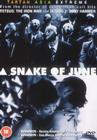
Director: Shinya Tsukamoto
Starring: Asuka Kurosawa, Yuji Koutari, Shinya Tsukamoto, Tomol Taguchi, Susume Terajima, Mansaku Fuwa, Teruki Hanahara.
Production: Shinya Tsukamoto
Distribution: Revolver
Year: 2002
Length: 74 '
A woman who works as a telephone operator in a mental health center, a husband who shuns the sexual contact because of an obsession for' physical hygiene and another man, a voyeur photographer, which is like a snake trap between the couple after she saved him from suicide.
It 's a terribly intricate and murky affair that Shinya Tsukamoto is at the center of his latest film, according to the same director as "the most strongly wanted and desired" of his career. Three people, even three people, embodied in a metropolis metal tank and stunned by the endless ticking of a flood that dilutes the majestic blue-Tsukamoto night in which he wanted to paint the black and white original film. A Snake of June is proposed to the viewer as an object elusive, symbolic, certainly artistic. Miser key reading and interpretation, the film strives for a wealth of sensations, impressions visual and explosions. Tsukamoto in fact organized the plot in a narrative maze that changes perspective Caracalla repeatedly from start to finish on the thin line between realism and sophisticated linear and far from a lyrical and dreamlike surrealism. The viewer is thus left without points of the compass, perpetually unaware or unsure of where he is: if in a dream, in a real place, an escape in the mind, in a flasback or in the future or beyond still undetermined. Although an association of ideas and a bit 'like a patient on the couch of a psychoanalyst, Tsukamoto speaks of grief, guilt, lack of communication, freedom and repression of the drives by selecting as thematic glue observation. Observation focused on the body, whose forms and expressions explain and describe being much more than the dialogues, often intentionally meager and insignificant. There is a husband who does not touch or even see more young wife and a voyeur who secretly photographed in his intimate moments of the forces abandonment, blackmail, to take a perverse game that is only meant to release repressed desires. "Do what you really want" the intimate, the photographer before discovering in the magnification of his shots, just as in Antonioni's Blow-up, something hitherto unseen simply because they saw. The irregular shapes of the breasts, the photographer Rinko understands the embryo of the same disease, a cancer that is ravaging also his meat. Erotic gaze of the voyeur is transformed into the clinical gaze of the doctor. In an attempt to restore the life that she had saved, the photographer Rinko forces to be examined. Operation would be sufficient to cure, the diagnosis is early, but the husband prevents the womb of the wife being mutilated. Rinko while abandoning himself to the husband, the photographer begins to haunt him dragging himself and the two spouses in a spiral of violence which, paradoxically, will lead each of the Atonement of their sins in a sort of redemption through sin.
A snake of june, as already mentioned, is not a film-friendly vision. However, if the viewer at the end resist the temptation to let him escape to his own wanderings and certainly for the aesthetic appeal of the staging, unusually rich in close-ups, details, shadows and mysterious symbols. Tsukamoto's gaze transcends the matter told the passes for reasoning on the form as when Rinko receives the first packet of photographs. The shots of the actress, moment by moment, in fulfillment of a movement explicitly sensual or erotic dall'intromissione back of the camera. Rinko sliding photos over each other and the movement seems to take place, slide the frames and the cinema ... accomplished. It just so happens that we remember Suddenly the film is nothing but an optical illusion that can imitate life thanks to the combination of 24 photographs at a later
.* * Review by Alessandro Montanari

